Pure fluid production
From steam to pure water and water for injections, the pure fluids used by process production equipment are numerous in the pharmaceutical industry.
Pure water parameters
Purified water
Water intended for the preparation of medicinal products other than those which are required to be sterile and free from pyrogens, except where justified and authorised.
Highly purified water
Water intended for use in the preparation of medicinal products where a high biological quality of water is required, except in cases where Water for Injections is required.
WFI (Water for Injections)
Water intended either for the preparation of medicinal products for parenteral administration with an aqueous vehicle (water for injections in bulk), or for the dissolution or dilution of substances or preparations for parenteral administration (sterilised water for injections).
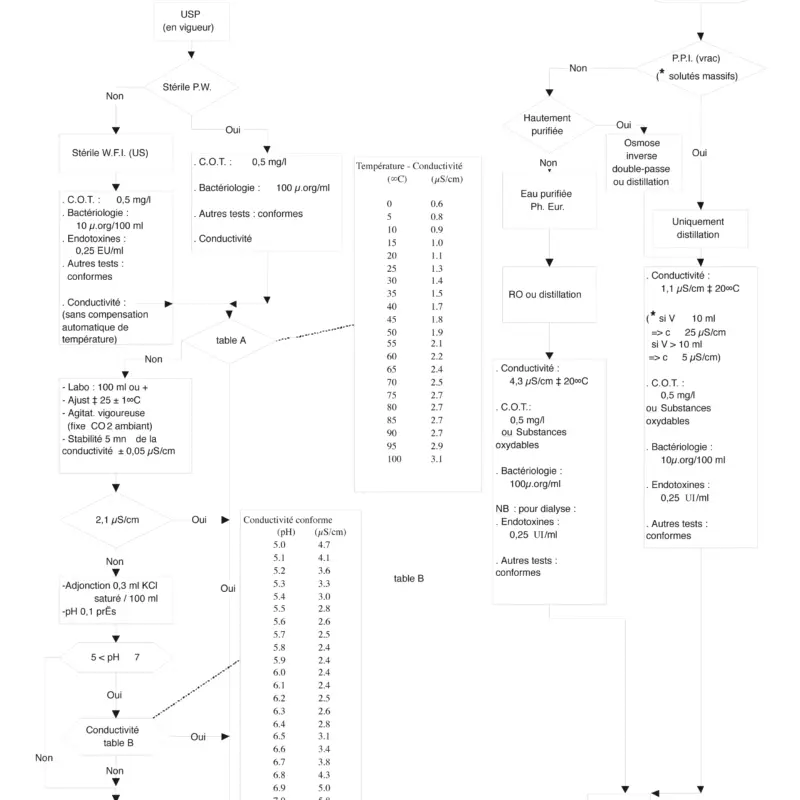
A review of the compliance requirements and recommended parameters set by the European Pharmacopoeia and the US Pharmacopeia for pure waters in the pharmaceutical industry, covering the following 4 points: conductivity, TOC, bacteriology and endotoxins.
Find the excellent WHO Good Manufacturing Practices report on water for pharmaceutical use.OMS
Report covering: general principles applicable to pharmaceutical water systems, water quality specifications, application of specific water qualities to pharmaceutical processes and dosage forms, water purification systems, water storage and distribution systems, operational considerations and inspection of water systems.
This document is a revision of the WHO Good Manufacturing Practices for water for pharmaceutical use, previously published in the WHO Technical Report Series, No. 929, Annex 3, 2005.
Water quality grades
Water quality may vary depending on the manufacturing stages, the final product produced or the standards applied. The following table shows the minimum acceptable water quality for the composition of pharmaceutical products.
| Drinking water | Purified water | WFI (Water for Injections) |
| Initial rinse for products. Final rinse for products (if equipment is dried after rinsing with 70% alcohol, this should be diluted with water of the same quality as that used for the final rinse). | Water for the sterilization of loads. | The "highly purified" WFI quality is acceptable if justified and validated, with depyrogenation following the final rinse of loads. |
| NON-STERILE pharmaceutical | NON-STERILE pharmaceutical STERILE pharmaceutical NON-INJECTABLE products | STERILE pharmaceutical INJECTABLE products |
As the table illustrates, each water purity level has its own specific application. The lower the quality, the more restricted its pharmaceutical use becomes due to the applicable standards and reference frameworks. Conversely, high-quality water will have more applications — until, at a certain purity level, it is classified as WFI and used in the composition of the most critical products.
STERIGENE and its partner STILMAS offer water production equipment. Depending on the process used, water purification can reach several levels — the highest in the pharmaceutical industry being that of Water for Injections (WFI).
Processes may differ according to client expectations and needs, but very often comprise a water pre-treatment system that ensures an initial quality of the output water. This is followed by EDI treatment to further improve quality, and then via one or more reverse osmosis stages, the recovered water is near-pure. A final treatment using a thermocompressor or distiller ensures WFI quality is achieved.
The different types of steam
The pharmaceutical or physico-bacteriological quality of water vapour is explained simply and concisely in the following table, comparing steam designations with feed water type, generation type and qualifying parameters.vapeurs d’eau
| Type | Feed water | Generator | Qualifying parameters |
| INDUSTRIAL | Softened 0–7° dH + anti-corrosion filming amines | Black steel Energy:
| Flow rate and pressure 0.95 < dryness fraction < 0.99 |
| FILTERED | Softened 0–7° dH + anti-corrosion filming amines | Black steel Energy:
| Flow rate and pressure 0.95 < dryness fraction < 0.99 Particulate reduction according to porosity (often 1 µm) |
| CLEAN | Treated without additives by demineralisation or reverse osmosis, bacteriologically clean (< 1,000 CFU/mL) | Body and contact surfaces in chemically neutral material: AISI 321, AISI 316L or AISI 316Ti stainless steel Energy:
| Flow rate and pressure 0.95 < dryness fraction < 0.99 Condensate (GMP Jan 2000):
|
| CLEAN (Food-grade) | Intended for human/food consumption, treated without additives by reverse osmosis or any other technique excluding ion exchange resins, bacteriologically clean (< 1,000 CFU/mL) | Body and contact surfaces in chemically neutral material: AISI 321, AISI 316L or AISI 316Ti stainless steel Energy:
| Flow rate and pressure 0.95 < dryness fraction < 0.99 Condensate:
|
| PURE | Purified* without additives (compliant with reference pharmacopoeias) | Body and contact surfaces in chemically neutral material: AISI 321, AISI 316L or AISI 316Ti stainless steel Energy:
No possible contamination* between primary and secondary fluids Low and controlled* upward velocity to reduce priming/blistering (recommendation: < 2 m/s)
| Flow rate and pressure 0.98 < dryness fraction < 0.99 Condensate*:
Sterility: < 10 CFU/100 mL Apyrogenicity: < 0.25 EU/mL Particulate level:
|
*These 4 quasi-normative elements are recommended by the profession for qualifying a Pure Steam Generator.
Pure fluid standards
Find the AFNOR and European standards on pure fluid production related to STERIGENE's activities.