Automatic cGMP washing
cGMP pharmaceutical washing is a validatable and repeatable process aimed at cleaning a load by decontaminating it using process washing equipment.
Cleanliness assurance
Analysis of soiling and contaminants prior to design and needs definition
This section aims to highlight a large number of points to be addressed in order to best define the washing process to be implemented. First and foremost, it is necessary to have a precise understanding of the input data — in other words, to know exactly what requires the use of the washing process.
The soiling: is it?
- Known and controlled (chemically, in terms of dimensions, source, vector…)
- Regular or random (what is the frequency of occurrence and kinetics?)
- Multiple soiling or a single contaminant
- Chemical, organic or both
- Soluble in water, acids or bases
- Dry or aqueous
- Present in uniformly distributed quantities or in thin layers on surfaces (issue: angles and pre-cleaning)
- Degree of adhesion resulting from any prior treatment: from deposits to incrustations, aerosol, reaction (laboratory equipment), baking (glassware)…
Definition of output data
Determine and set out in writing, from the design stage, the cleanliness objective, i.e.:
- The quantifiable result WITH its acceptance criteria (operational, alarm and stop ranges)
- The probable Cleanliness Assurance Level (CAL) — not the means
Definition of needs and process
Is the objective to reduce or eliminate all or part of:
- Particulate contamination? (Which type — size — threshold…)
- Microbiological contamination? (From disinfection through to sterilization — endotoxins)
- The risk of cross-contamination?
Are the same thresholds required for all items?
Reference frameworks, operators, products. What airflow classification is required at the outlet?
- No visible trace to the naked eye or to a specific detector
- < 1 particle/1 µm
- < 2 particles/2.5–20 µm
- No particles/25 µm
Are the objectives:
- Technically realistic?
- Qualitatively quantifiable?
- Economically viable?
- Consistent with the risk/criticality? (RPN = OC x SP x ND)
Only after addressing these various questions can we consider the means and their specific parameters.
Any investment in upstream knowledge and parametric analysis (QbD) remains a latent source of savings in terms of productivity and quality, in light of the risks envisaged for process control.
cGMP washing method
Efficiency & effectiveness of cGMP washing
The efficiency of cGMP washing results from the chemical actions of the product used — breaking the bonds between the load substrate and its soiling — and mechanical actions, with rinsing flushing away the contaminants.
The effectiveness of each action is proportional to the duration of exposure to the treatment, but they are inversely proportional to one another: the more intense the chemical action, the less powerful the mechanical action needs to be for the same cleanliness assurance level, and vice versa.
- Chemical action: wetting, soaking, immersion, spraying, dissolution…
- Mechanical action: wiping, brushing, friction, blowing, vacuuming, jetting…
cGMP washing is an essential operation in the manufacturing cycle of active pharmaceutical ingredients and pharmaceutical products. Every process operates between a cleanliness assurance level and a contaminant acceptance level.
The recommendations and indeed legal obligations of GMP guidelines — in particular with regard to the minimum quality of water usable in processes — strictly govern cleaning operations and must be understood and integrated at the design stage in order to select the appropriate techniques and equipment.
Optimisation of cGMP washing
Optimisation of chemical and mechanical actions will be achieved through expertise and work on fundamental parameters such as concentration, temperature, flow rate, time and reproducibility.
The choice of washing equipment must be made on the basis of input data (detailed description of soiling) and output data (required specifications, quantifiable results…). Based on this data, the appropriate means must be identified and parameter optimisation pursued.
From a mechanical standpoint, friction is influenced by pressure, the angle of attack and the abrasion ratio at interfaces.
The higher the pressure, the lower the flow rate (for economic reasons).
The higher the flow rate, the lower the pressure (more traditional approach).
Today, 80% of industrial processes use low pressure, but the proportion using high pressure has been steadily increasing in recent years.
At the level of production procedures and routines: manual procedures and automated programmes (number — duration — sequences of successive phases…)
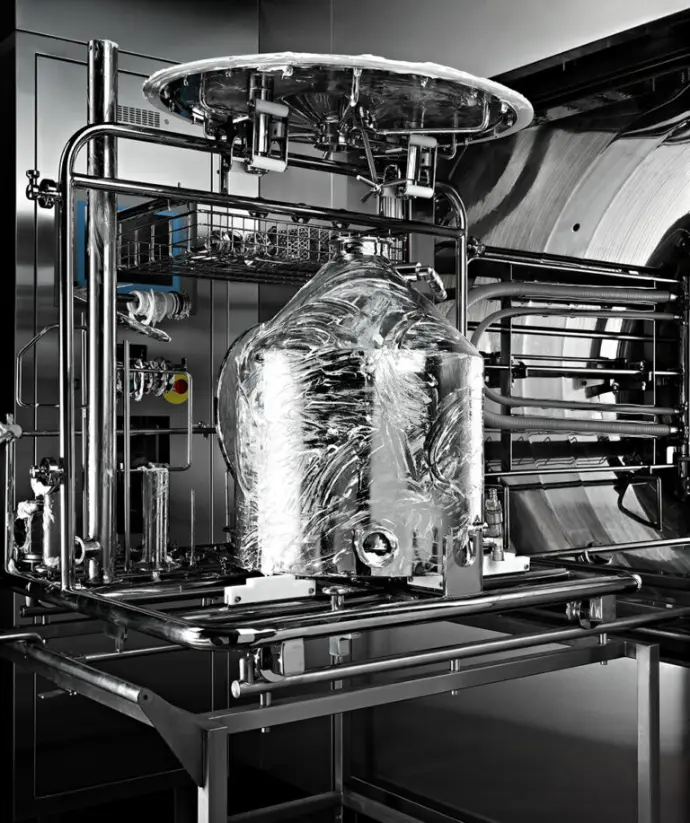
At the level of equipment design: pharmaceutical washers, either static or mobile, for Cleaning In Place (CIP)
At the level of the quality of the means employed: finishes ensuring reproducibility (geometry, assembly, sealing) as well as inclination and dead legs…
This enables the most suitable equipment to be selected.
Our dedicated, highly practical training modules enable a confident approach to washing and drying challenges, from design through to qualification.
GMP washing standards
Find the AFNOR and European standards for GMP washing related to STERIGENE's activities.