A STERIGENE article in Industrie Pharma: Survey — How manufacturers are getting ahead of the regulations on visual inspection of injectable products
Published on 14/02/2024
Increasingly popular among manufacturers, the visual inspection of injectable products is undergoing a technological revolution. A transformation that, at present, is not yet reflected in the European regulatory texts, which stipulate that the human eye remains the reference standard.
Alexiane ROUPIOT – 07/11/23 – Usine Nouvelle

ANNEX 1 OF EU GMP ON THE VISUAL INSPECTION OF INJECTABLE PRODUCTS
Having come into force in August 2023, Annex 1 of the Good Manufacturing Practices (GMP) guidelines on the manufacture of sterile medicinal products sets out the objectives to be achieved in terms of visual inspection of injectable products, and provides recommendations on the methods to be used to meet them. This text supplements the European Pharmacopoeia, in which particulate contamination of parenteral products is addressed in a few lines under chapter 2.9.20. Nevertheless, the European regulation on the visual inspection of injectable products still presents certain gaps. "In practice, the text most commonly used as a reference for the visual inspection of injectable medicines in Europe is chapter <1790> of the United States Pharmacopeia," observes Christophe Assire, co-founder of QP Pharma, a consulting and services company in the pharmaceutical industry.
"Visual inspection is an extremely complex production step, sitting midway between manufacturing and quality control — I believe it warrants a dedicated annex," advocates Ludovic Prost, Managing Director of QP Pharma. In the meantime, players in the pharmaceutical industry are taking the initiative. Despite the regulatory gaps, they are innovating to optimise the visual inspection of sterile parenteral products, with the aim of ensuring greater patient safety while maintaining economic viability. And although it is not explicitly mentioned in European texts, automated visual inspection is at the heart of most of these innovations. "In France, the trend is towards increased use of automated visual inspection," states Romain Veillon, Global Visual Inspection Expert at GSK.
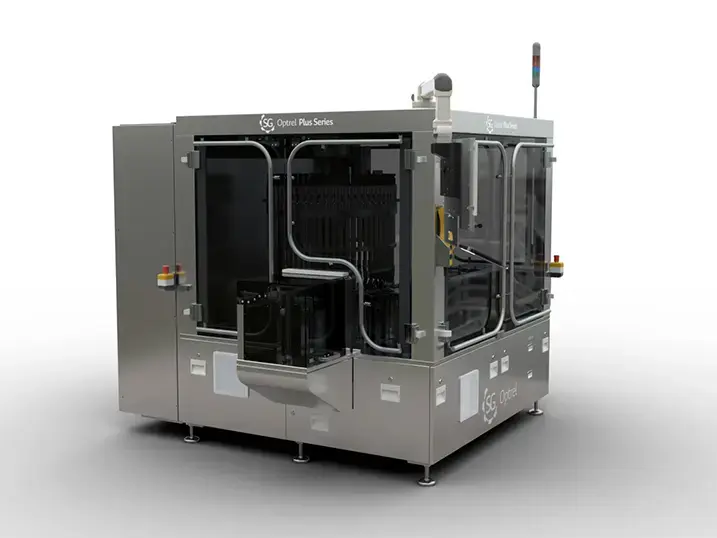
"Whenever possible, we try to use automated visual inspection for injectable products," agrees Olivier Chauvet, Project Manager, Manufacturing and Supply, at the Sanofi vaccines site in Val-de-Reuil. To justify this choice, manufacturers highlight the better reproducibility and higher throughput of automated visual inspection. "In manual inspection, an operator inspects an average of 1,000 to 2,000 units per day. On a semi-automatic machine with 3 or 4 operators working simultaneously, this rises to 2,500 units per hour. And an automated inspection machine inspects 36,000 units per hour," quantifies Ludovic Prost. Sanofi
Powerful image analysis algorithms
On these high-speed machines, the technological revolution is being driven by digitalisation. On one hand, the vision systems with which they are equipped are increasingly powerful. "Their resolution has increased considerably: fifteen years ago, around thirty images were taken per vial, whereas today 450 images are captured in the same timeframe," illustrates Romain Veillon. Added to this is the increased power of image analysis algorithms through the use of artificial intelligence (AI). "The latest generation of automated inspection machines are capable of self-learning: they continuously improve their ability to distinguish defective units from compliant ones, beyond their initial qualification level," indicates Olivier Chauvet.Some automated equipment is even beginning to incorporate deep learning technologies, which use neural networks to mimic the human brain's learning process. In February 2021, for example, German manufacturer Syntegon installed its first visual inspection system — equipped with AI using deep learning algorithms — in a fully automated and validated machine on Amgen's production line. The laboratory uses this new system to reliably distinguish air bubbles — at the rubber stopper of the syringe — from foreign particles. According to Syntegon, their system has increased the particle detection rate by 70%, while reducing the false detection rate by 60%.
At GSK's Saint-Amand site, the digital revolution is also underway. By 2025, automated inspection machines will process visual inspection images using deep neural networks. "For these AI systems to work, we need to store large quantities of data, so we made an initial investment to purchase servers dedicated to storing defect images that will subsequently feed the neural networks," explains Boris Van Waes, Head of Visual Inspection at the Saint-Amand site. "We are also working to guarantee the integrity of the data used and compliance with cybersecurity rules," emphasises Romain Veillon. GSK
Digitalising qualification?
However, the digitalisation of automated visual inspection is not limited to the inspection process itself — it also encompasses the upstream stages of equipment calibration and qualification. "Initially, qualification was based solely on trials: defective items presenting defects in different categories were passed through the machine, and we verified that it had detected them with a sufficient detection rate," recalls Olivier Chauvet. Nowadays, manufacturers such as Brevetti Angela and Stevanato offer simulators that, using images of targeted defects, can anticipate the behaviour of the inspection machine based on its parameter settings. For manufacturers, this simulation tool represents a considerable time saving in the development of vision recipes. Brevetti Angela Stevanato
"Rather than conducting large-scale trials, which are resource-intensive, simulation makes it possible to define a restricted range of parameters to be tested," points out the Sanofi Project Manager. "While the simulator is running, the automated inspection machine can continue its visual inspection," Ludovic Prost reminds us. "For the manufacturer, this represents a significant productivity gain," he continues.
At its Saint-Amand site, GSK even plans to extend digitalisation to equipment qualification through the deployment of digital twins of its inspection machines. "A virtual machine will be used to qualify new vision recipes developed by AI from virtual defect units. We will deploy the digital twins and all the necessary infrastructure between January 2024 and the end of 2025. Testing phases are currently underway," announces Boris Van Waes.
In the manufacturing sector, the digital revolution is well underway. But for it to bear fruit, it must go hand in hand with a reform of training practices (see box) and an evolution of the regulatory framework. At present, the term "artificial intelligence" does not appear in European texts. However, the European Medicines Agency published, in July 2023, a reflection paper on the use of AI in the lifecycle of medicinal products. And in France, in January 2023, the ANSM and the LEEM launched a working group on the role of AI in the pharmaceutical industry.
pharmaceutique.
"These discussions send a strong signal that supports our innovations," welcomes Romain Veillon.
"Automated systems are less effective than humans at discerning reading artefacts, reflections or subtle colour variations," Olivier Chauvet (Sanofi).
Manual visual inspection: the reference standard
Alongside this digital transformation, automated visual inspection machines are increasingly incorporating new inspection technologies in the broader sense. Italian group Stevanato, for example, offers the option of equipping all its automated inspection machines either with a high-voltage leak detection system to identify microcracks in liquid-filled containers, or with a gas analyser to test lyophilised product containers. "In 2025, we will deploy new automated inspection machines incorporating high-voltage leak detection technology with the latest developments in power supply and electrodes to improve detection performance," announces Boris Van Waes.
Furthermore, the use of other technologies such as infrared spectrometry and X-ray inspection is being considered for the visual inspection of more complex injectable products, such as solids or lyophilised formulations. For apart from the detection of particles in liquid products, automated visual inspection still does not match the performance of the human eye. "Automated systems are less effective than humans at discerning reading artefacts, reflections or subtle colour variations," adds Olivier Chauvet. As such, manual visual inspection is still widely used by manufacturers to inspect coloured, oily or small-volume injectable substances. Similarly, products manufactured in small batches are often inspected manually for cost reasons. On one hand, since the unit cost of each item is generally very high, manufacturers seek to minimise the false rejection rate. Yet "more than 99% of units ejected by an automated inspection machine are compliant," underlines Boris Van Waes.
Furthermore, the qualification of automated equipment can prove too complex to be cost-effective for small batches. "There was a time, at our Val-de-Reuil site, when we produced very specific syringes in small series. Qualifying an automated recipe for all defect types, taking into account the particular characteristics of the syringe, would have been too complex to be cost-effective," recalls Olivier Chauvet. Moreover, at present, manual visual inspection of injectable products continues to serve as the reference standard. On every batch inspected — whether by automated, semi-automated or manual means — an Acceptable Quality Level (AQL) control is carried out manually on a statistically representative sample of the batch, to ensure the absence of any process drift relative to validated parameters. "The human eye continues to monitor what the machine does," summarises Olivier Chauvet.
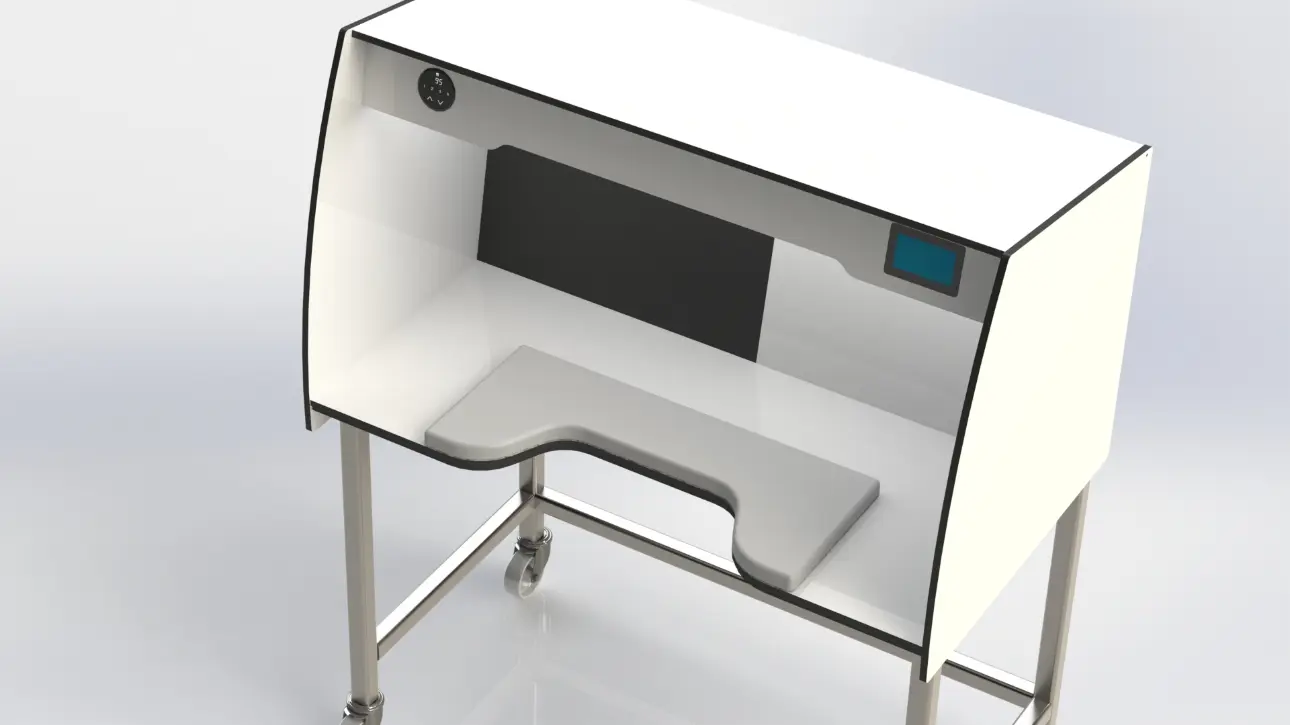
Manufacturers and equipment makers are therefore also innovating in the field of manual visual inspection. More comfortable chairs, height-adjustable tables, unit handling aids, lighting designed to minimise reflections… "Technological innovation is primarily focused on ergonomics, to improve operator comfort and working conditions," summarises Ludovic Prost. A member of the SYNEXIN Group, STERIGENE — a specialist in process equipment, particularly for the pharmaceutical industry — will unveil, in early 2024, the fifth model in its standard manual inspection table range. "To ensure reproducibility of the inspection environment, all elements of the CleanView table are fixed. However, it is mounted on telescopic legs that allow the operator to adjust the table to their height," details Franck Delannoy, Head of Training, Audits and Advisory Services at STERIGENE. Each year, the company sells around one hundred manual inspection tables, of which approximately 70% are standard models. SYNEXIN sa table standard de mirage manuel « Pour maîtriser la reproductibilité de l’environnement de mirage, l’ensemble des éléments de la table CleanView sont fixes. En revanche, elle est montée sur des piétements télescopiques qui permettent à l’opérateur d’ajuster la table à sa hauteur », détaille Franck Delannoy, responsable du pôle de formations, audits et conseils chez STERIGENE. Chaque année, l’entreprise commercialise une centaine de tables de mirage manuel, dont environ 70 % sont des modèles standard.
Towards the digitalisation of visual inspection training?
The digital transformation of automated visual inspection, and the large volumes of data associated with it, will give rise to new skills requirements. "We will adopt an upskilling approach, supporting our vision engineers to progressively build their expertise in server management, database handling and cybersecurity," anticipates Romain Veillon, Global Visual Inspection Expert at GSK. Moreover, "while technologies evolve, they are always benchmarked against the performance of the human eye," recalls Olivier Chauvet, Project Manager, Manufacturing and Supply at the Sanofi vaccines site in Val-de-Reuil. "And that is precisely why the training of manual inspection operators is paramount," he insists.
"The qualification and training of injectable product inspection technicians are time-consuming and require available equipment," also highlights Joël Rancœur, Director of Industrial Training Development at the IMT Group. To help manufacturers overcome these constraints, the IMT Group is working with some of its clients on the digitalisation of operator training and qualification. "Rather than having all operators come before an inspection table one by one, the idea is for them to review the different vials together via video, in order to save time," explains Joan Leclerc, Head of Digital Innovation at the IMT Group. In the short term, if regulations permit, the IMT Group hopes to make these videos available for the qualification of inspection operators. "We have not yet raised the subject with the ANSM," acknowledges Joan Leclerc. Groupe IMT
Infinite possibilities for innovation
Beyond that, bespoke equipment is developed to meet customer specifications. "We developed a special table for inspecting injectable bags: we installed a hook to support the bag, integrated two light sources and a backlit panel," illustrates Laurent Meilhaud, Head of Manual Inspection Development at STERIGENE. "With custom-made tables, the possibilities for innovation are endless!" he enthuses. Furthermore, certain technologies already present on automated and semi-automated visual inspection equipment could soon be incorporated into manual inspection tables.
"An increasing number of major pharmaceutical industry players are asking us to guarantee data integrity and to integrate new functions into our manual inspection tables, such as inspection time monitoring through motion sensors and timers, or rejection count control through the addition of chutes to count the units rejected by the operator," details Laurent Meilhaud. "We are working on prototypes incorporating these new functions," he adds.
"These features could be valuable in ensuring that the operator's full attention and cognitive capacity are focused on defect detection, without having to manage the logistical aspects," welcomes Christophe Assire. All of these innovations have been developed by manufacturers with a single objective: to minimise defects in sterile injectable products to the greatest possible extent. It should be noted, however, that visual inspection is merely a verification step to confirm the absence of defects. The results of injectable product visual inspection are all the better when the manufacturer has maintained control over every stage of its process — in particular by working upstream with its primary packaging suppliers.