Barrier technologies
Safety devices used to protect medicines and pharmaceutical products from contamination and unauthorised handling.
For medicine manufacturers, protecting products and operators from contamination is a major challenge. The slightest doubt regarding the integrity or sterility of a batch has significant consequences:
- Financial: with the destruction of the batch in question and the temporary shutdown of the production line concerned
- Human and public health: if the contamination is not detected in time
- Reputational: impact on brand reputation
Contamination control is also a major focus of pharmaceutical Good Manufacturing Practices (GMP). Barrier technologies (RABS & Isolators) address these challenges. They are safety devices used to protect medicines and pharmaceutical products from contamination and unauthorised handling. Their purpose is to guarantee the integrity and quality of pharmaceutical products, to protect patients from potentially dangerous or compromised medicines, and to protect operators.
What is a barrier technology?
Definition of barrier technologies
In the pharmaceutical industry, Good Manufacturing Practices (GMP) place particular emphasis on the implementation of good practices to prevent contamination. Barrier technologies aim to ensure the protection of sterile production and the management of incoming and outgoing flows.
In concrete terms, a barrier technology refers to a system enabling the separation of the process from the operator in order to:
- Prevent cross-contamination
- Separate spaces (separate extraction of exhaust air/waste)
- Protect operators in the case of toxic products/containment
- Protect the product
- Enable grade transitions
Barrier technologies include isolators and RABS.
What is an isolator?
According to the EU GMP guidelines, an isolator is defined as "a decontaminated unit supplied with Grade A (ISO 4.8) or higher air quality, which provides continuous and unbroken isolation of its interior from the external environment (i.e. from personnel and the air present in the immediate controlled atmosphere environment)."
An isolator is an enclosed space, designed and used in such a way as to prevent the product or materials from being exposed to the room environment.
Materials may be introduced into a closed system, but any addition must be made in a way that avoids exposing the product to the room environment (for example, through sterile connections or fusion systems).
It may be necessary to open a closed system (for example, to install a filter or make a connection), but it must regain its closed-system status through a decontamination or sterilization operation before being used.
What is a RABS?
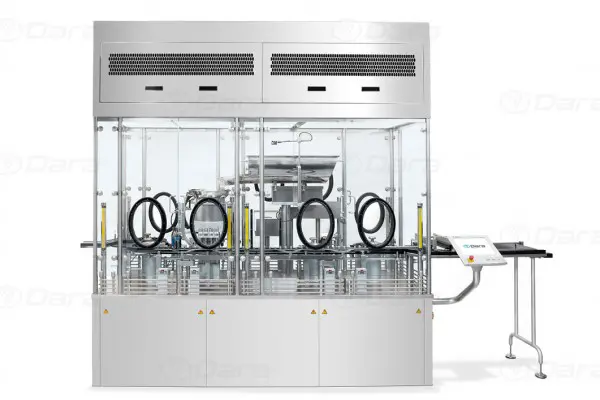
A RABS (Restricted Access Barrier System) is a combined system of physical (rigid) barrier and aerodynamic protection around the critical zone.
Depending on the level of protection required in your context and other criteria such as the performance of your HVAC (Heating, Ventilation and Air Conditioning) system, you can opt for different types of RABS.
In a passive RABS, the HEPA filters are part of the zone. This means that your HVAC system must be sufficiently performing in terms of airflow velocity and filtration level.
A RABS is described as active when the HEPA filters are part of the machine.
An open active RABS refers to a system that is open at the bottom with air discharge and recirculation through the client's HVAC system.
In contrast, in the case of a closed active RABS, the system is closed with integrated air recirculation. In other words, the air always remains within the system and does not recirculate through your HVAC.
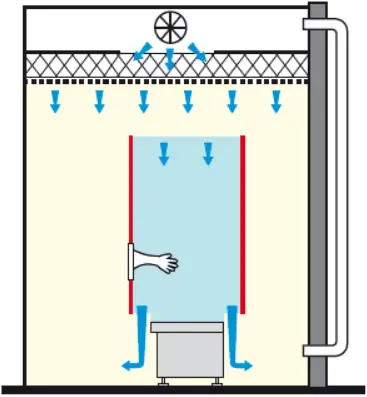
Passive open RABS
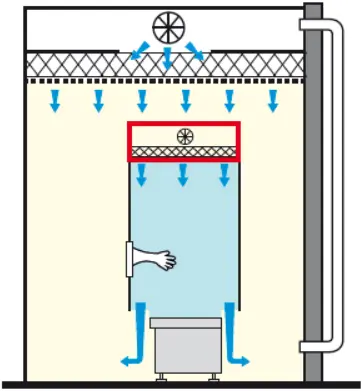
Active open RABS
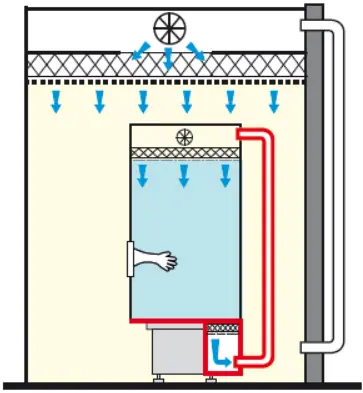
Closed active RABS
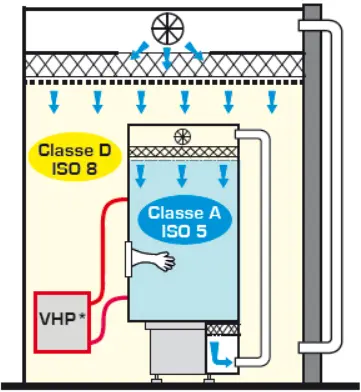
Isolator
In what cases are barrier technologies used?
The EU GMP guidelines specify the cases in which barrier technologies are to be used. They are mandatory for:
- ATMPs: Advanced Therapy Medicinal Products (gene therapy, immune deficiency in patients)
- Viral vectors
- GMOs
In addition to protecting products, barrier technologies also aim to protect operators through containment measures. This dimension also influences the choice between one system and another.
In practice, the approach begins with a risk analysis. The manufacturer must be able to justify their choices to the Medicines Agency. The manufacturer must obviously take into account the financial, human and reputational risks in the event of any doubt regarding the integrity or sterility of a batch.
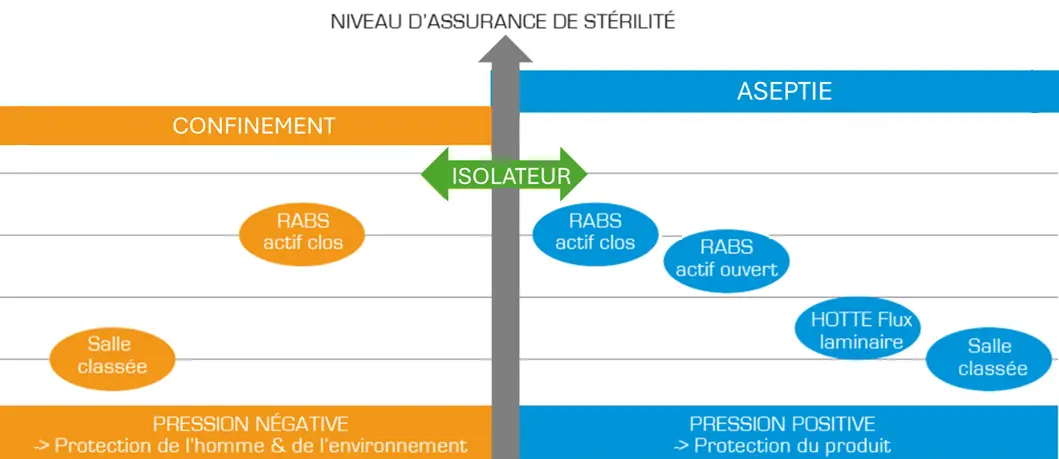
Barrier technologies are used in the context of production (aseptic filling, particularly for injectable products) and at quality control level.
Depending on the criticality of the product, a more or less closed system will be used. The more closed the system, the higher the level of sterility assurance.
3 use cases for barrier technologies
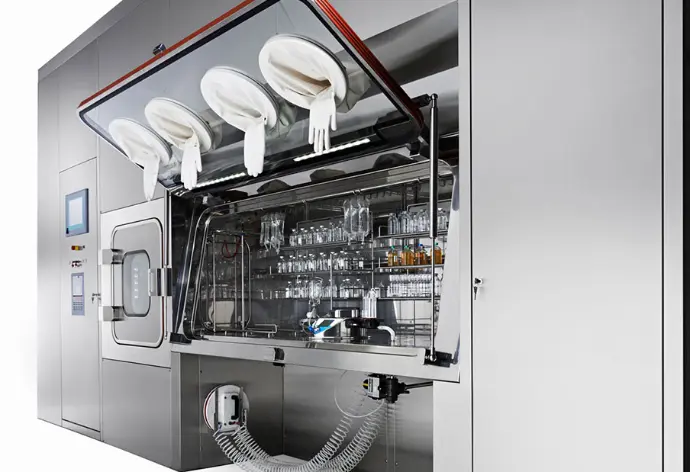
Sterility testing isolator
In this first example, the equipment is used to carry out sterility tests on samples from production lines, as part of a quality control approach. The aim is to demonstrate, statistically, that the entire batch is indeed sterile.
In accordance with the isolator principle, the space is separated from the operator. It is equipped with gloves to prevent operator handling of and exposure to the product.
The system enables H₂O₂ decontamination of the entire chamber to enable work under sterile conditions. It is fitted with an airlock for the entry and exit of materials. The airlock enables materials to be decontaminated before entering the isolator itself.
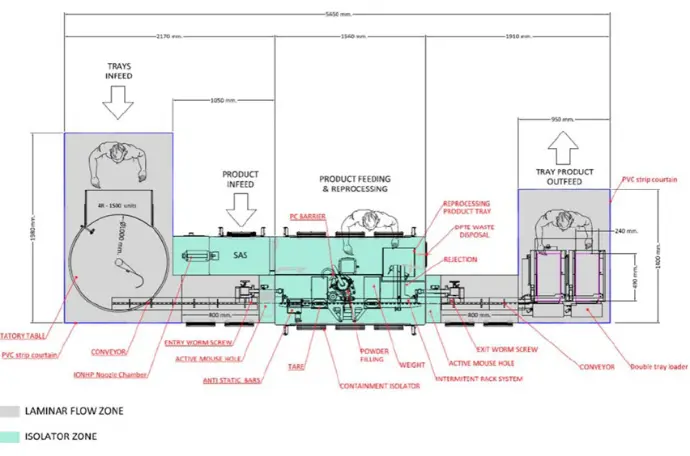
Filling isolator
In this case — involving IPSEN — the isolator is used in the context of hormone production and, more specifically, at the filling stage. The primary challenge is to protect the operator from the product, whose active ingredient is extremely potent.
The equipment was designed to:
- Maintain the leakage level < 1% vol/h
- Comply with ISO 14644 classification: 3
- Chamber pressure at +50 Pa ±10 Pa ISO 8
This system operates in a hybrid mode with:
- An isolated zone (shown in green in the diagram) when the product is present
- A laminar airflow zone (shown in grey) for the entry and exit of materials, with a lower level of containment
The system operates with very fine control over aerodynamic parameters to maintain the desired containment level from one zone to another, within an overall negative pressure environment. Aerodynamic barriers, placed between the compartments, maintain the pressure differential between adjacent compartments.
Isolator for different types of containers
The third case corresponds to a production line involving several types of containers: cartridges, syringes and vials.
The PCA production line is arranged in an L-shape with a series of compartments. Between them, these compartments are linked by a pressure cascade.
The isolator ensures product sterility precisely because manufacturing takes place in a positive pressure environment that protects it from external contaminants.
In this system, certain compartments are used specifically depending on the type of container to be produced.
Our barrier technology solutions
You have completed your risk analysis and are looking for the ideal solution to maintain the aseptic conditions of your pharmaceutical products.
Balancing the level of protection, budget constraints and potential risks is not always straightforward. Depending on your production challenges and the criticality of the products concerned, you do not necessarily require a uniform containment level across all compartments of your production line.
Our experts help you select the barrier technologies suited to your situation.
Do you need a transfer solution?
Article 4.11 of the new EU GMP Annex 1 states:
"The transfer of materials, equipment and components into Grade A or B areas should be carried out through a unidirectional process. [...] When sterilisation during transfer of items is not possible, a procedure that achieves the same objective of not introducing a contaminant must be implemented." The introduction of materials or components into a barrier technology environment must therefore be carefully studied in order to avoid introducing contamination.
STERIGENE supports you in implementing transfer solutions via RTP ports for packaging components (stoppers, inserts, caps…) and the equipment required for cleaning operations in isotechnology:
- Feasibility study
- Implementation of the analytical approach with a certified laboratory:
- Validation of microbiological analytical methods in accordance with the annexes of NF EN ISO 11 737
- Bioburden analysis, definition of the verification dose, treatment and sterility controls
- Treatment at the maximum dose for gamma sterilization
- Carrying out performance qualification in accordance with standard 11 137-3
- Filling of sterile beta bags in our cleanroom*
- Possibility of scheduling deliveries by production batch
- Provision of a regulatory validation file (analytical, sterilizing dose, etc.)
Do not hesitate to contact us to find out more.
* The SYNEXIN Group, of which STERIGENE is a member, is part of the WhiteBox Alliance collective.