Airborne Surface Disinfection
Airborne Surface Disinfection (ASD) is an automated process aimed at the homogeneous disinfection of all surfaces in the target zone.
In the context of medicinal product manufacturing, production takes place in controlled environments. The objective is to maintain the quality, safety and efficacy of the medicines produced by minimising contamination risks. In these environments, airborne particle levels are strictly controlled. Manufacturers also design and monitor controlled environments to minimise the presence of micro-organisms and bacteria, in particular through rigorous cleaning and disinfection procedures.
The EU GMP guidelines define the good practices to be implemented by manufacturers. Bio-decontamination features as a critical production step for eliminating waste and particulate, biological and chemical contaminants deposited on surfaces. Within the overall bio-decontamination process, ASD (Airborne Surface Disinfection) contributes to the disinfection stage. The reform of Annex 1 of the Good Manufacturing Practices has even made it an indispensable element.
ASD: a key element of bio-decontamination
The objective of bio-decontamination
Bio-decontamination consists of restoring equipment or premises to a state of cleanliness:
- Following production anomalies (emergency activity)
- Between two batches or according to a planned schedule (planned activity)
It encompasses a series of steps aimed at eliminating/reducing contaminants in the production environment in order to:
- Achieve visually clean surfaces
- Bring particulate levels within acceptable limits according to the zone classification
- Bring microbial levels within acceptable limits according to the zone classification
The "acceptable" particulate and microbial concentrations are defined in Annex 1 of the EU GMP guidelines, updated in August 2022.
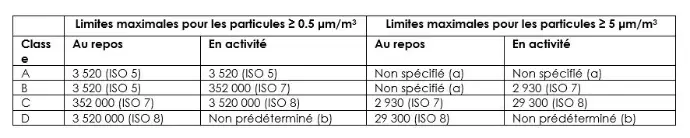
In accordance with GMP guidelines, the manufacturer is required to carry out continuous monitoring of its production environments to maintain contamination below the thresholds corresponding to the defined classification.
A regulated production step
The revision of GMP Annex 1 requires manufacturers to:
- Adopt a clear and concise contamination control strategy
- Establish a defined quality system based on the principle of Quality Risk Management
In other words, the manufacturer must assess the risks inherent to its production environments and processes, then implement the means to reduce those risks. To this end, the GMP guidelines provide a framework to help players identify, scientifically evaluate and control all potential risks during the process.
Compared to the previous version of the GMP guidelines, the revision of Annex 1 raises the requirements in terms of bio-decontamination. To achieve compliance, we now recommend following 8 steps:
- Pre-cleaning: removal of visible manufacturing waste to facilitate subsequent cleaning
- Dust removal: particulate and chemical decontamination by vacuuming or damp sweeping
- Washing/detergency: optional use of detergents to detach contamination from the surface
- WFI rinsing where detergents have been used, to suspend residues
- Wiping: mechanical action to remove residues
- Disinfection to eliminate/reduce micro-organisms
- WFI rinsing if necessary
- Wiping after rinsing to remove disinfectant residues
What do the GMP guidelines say about disinfection?
The revision of GMP Annex 1 provides clear guidance on disinfection expectations.
Article 4.33 specifies several points:
Disinfection must be based on a formalised programme
Prior cleaning must be carried out to eliminate surface contamination
More than one type of disinfecting agent must be used
Disinfection must include the periodic use of a sporicidal agent
Further in the text, important additional details are provided. The process must take into account the appropriate contact time and the manner in which disinfectants are used and the surfaces on which they are applied. Regular monitoring is expected to ensure the effectiveness of the process. Cleaning programmes must effectively eliminate disinfectant residues.
Finally, for the first time, ASD is explicitly cited in the text as a good disinfection practice.
Why and how to implement ASD?
What is ASD?
Airborne Surface Disinfection is an automated process aimed at the homogeneous disinfection of all surfaces in the target zone. By disinfection, we mean the operation with a momentary result consisting of destroying, eliminating or slowing the development of micro-organisms and/or inactivating undesirable viruses.
ASD consists of dispersing a biocidal product (disinfectant) in the form of a gas, vapour and/or aerosol from a dedicated device. It targets surfaces rather than air. It does not require human intervention.
In the process of restoring a zone to compliance, disinfection is the final step prior to cleanroom qualification. It takes place after manual cleaning. It must be carried out with care and requires full validation.
ASD standards
ASD is a process governed by:
- A French standard: NFT 72 281
- A European standard: EN 17 272
These standards verify the efficacy of the disperser/product combination through the logarithmic reduction achieved by the product. They also determine the bactericidal, yeasticidal, fungicidal, sporicidal and virucidal activity of the process.
The EN 17 272 standard is an evolutionary reform of the NFT 72 281 standard. It differs from it in the following respects:
- A stronger requirement in terms of dispersion homogeneity
- Efficacy against certain additional types of micro-organisms
- Clearer testing requirements with regard to the volume of the enclosure
- The introduction of the concept of overall contact time of the disinfecting agent
Finally, the biocidal products regulation BPR No. 528/2012 governs biocidal products. It aims to harmonise and control the placing of these products on the market at a European level.
The efficacy of biocidal products is also standardised. It is governed by a European umbrella standard EN 14 885, which:
- Facilitates product comparison for users
- Establishes the standards that a biocide must meet in order to claim microbicidal activity
- Defines the standards to be met according to sectors of activity, applications and claimed efficacies
HPE technology
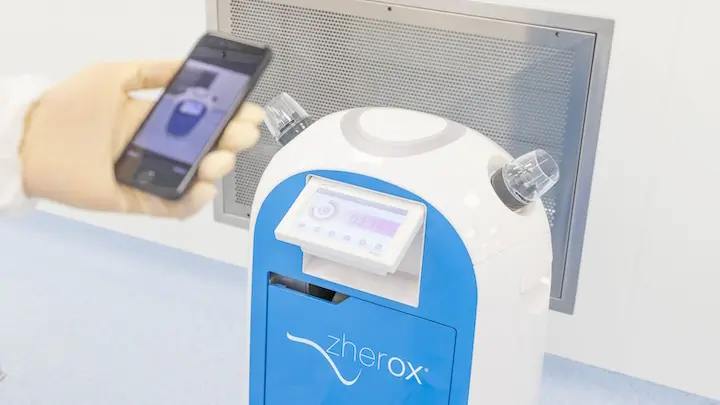
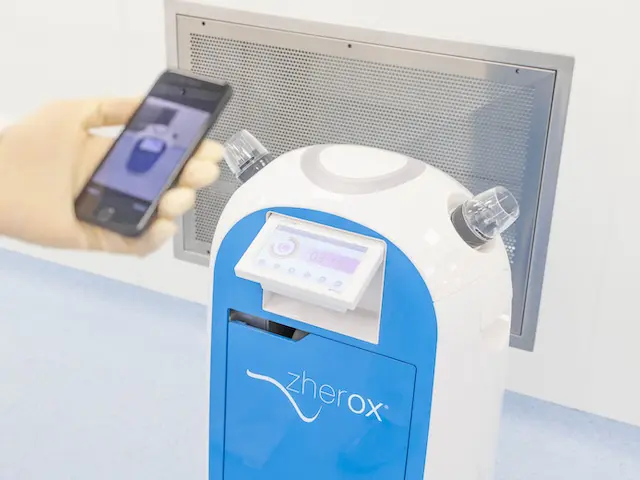
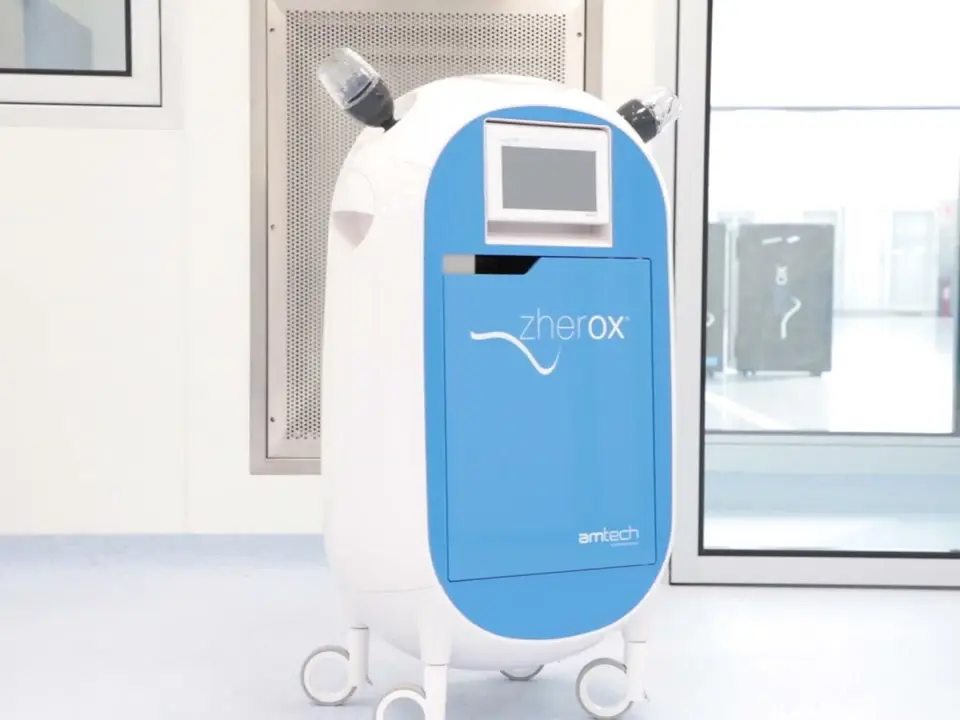
ASD relies on a machine/product combination that cannot be modified. The HPE technology we offer our clients combines an H₂O₂ solution with a mobile ZHEROX unit that can be networked to treat larger volumes. The ZHEROX machine can be triggered remotely via a dedicated application that enables management of the device and collection of activity reports.
Thanks to this technology, a hydrogen peroxide (H₂O₂) solution at a concentration below 8% is dispersed in microdroplets that then pass through a high-voltage electromagnetic field and undergo ionisation. Disinfection is achieved through the action of free radicals. The electromagnetic field imparts an electrostatic charge to the dry mist, ensuring homogeneous dispersion across surfaces and leaving no residue.
HPE technology offers several advantages:
- Efficacy against a broad spectrum of contaminants
- Speed of execution
- Safety with respect to treated surfaces
It has obtained compliance with BPR No. 528/2012, NFT 72 281 and EN 17 272 standards. In terms of performance, ZHEROX achieves a 6-log reduction in 3 hours at a reduced cost, covering 100% of the surface area thanks to ionisation.
Disinfection is a key step in bio-decontamination. As the revision of GMP Annex 1 has strengthened the requirements in terms of contamination control and quality risk management, ASD has become indispensable.
By choosing HPE technology, you benefit from a solution combining effectiveness and competitiveness, fully aligned with applicable standards. Beyond the technology itself, STERIGENE's teams support you in developing your disinfection strategy (audit, advisory services, qualification, staff training and maintenance).
Which ASD solutions should be implemented?
Find a selection guide to help you implement your airborne surface disinfection strategy.
Our ASD solutions for your zones
Services
On-site interventions for bio-decontamination activities via ASD, tailored to your critical needs and intervention schedule.
Services
On-site interventions for bio-decontamination activities via ASD, tailored to your critical needs and intervention schedule.
Equipment supply
Purchase of one or more ASD systems or an integrated module for your premises to meet your larger-scale needs.